FIGHTING FITNESS JUDO · THE ROAD TO BLACK BELT
Nobody Starts at the Summit
Why every grading between white belt and black matters, and why black belt is the start of something bigger.
By Vince Skillcorn, Head Coach
Your five-year-old is standing on the mat in their first ever judo suit which their auntie thought was a very snazzy pair of pyjamas. It is his first grading. You moved a meeting to be here, and your phone is ready.
The coach calls his name. He bows. He lies on his back, tucks his chin and slaps the mat with both arms. He rolls. He balances on one leg, wobbles, falls over, and bounces straight back up grinning.
And a small voice asks: is this it? Is this martial arts?
Yes. This is where martial arts starts. Give me a few minutes and I will show you why.
Almost nobody starts for the belt
Hardly anyone walks through our door wanting a black belt.
Parents bring a child who is shy, or a child with more energy than the house can hold. Adults come to get fit, or because they reached a certain age and decided they were not finished yet.
Some tell me on their first night that they want a black belt. I believe them. But talk a little longer and it is rarely the belt they want. They want to be the person who could earn one. The person who turns up on a cold, dark Tuesday in January when the sofa is calling. The one who gets thrown and asks to go again.
That person is not made in a night. They are made over years, one grading at a time.
The alphabet comes first
People often compare our gradings to school. No five-year-old starts a master’s degree. They learn the alphabet, then the sounds the letters make, then how to add and take away. Each year stands on the one before it.
Judo works the same way. You learn to move your body. You learn the rules. You learn to fall long before you learn to throw.
That comparison works for many people. I prefer a mountain. Indulge me for a minute: I want to take you back before I bring you to where we are today.
The first person to look up
At some point, someone stood at the foot of Everest and decided to reach the top. There was no route. No guide. Nobody to tell them what the air would do to their body five miles up. Only the thought.
The early attempts were brutal. The first British expedition, in 1921, spent months looking for a way on to the mountain. In 1924, George Mallory and Andrew Irvine were spotted high on the north-east ridge, still climbing. Then the cloud closed in, and they were never seen alive again. It took more than a dozen attempts and thirty-two years before Edmund Hillary and Tenzing Norgay reached the summit on 29 May 1953.
Every failure left something behind for the next team. Don’t climb alone. Don’t climb in a storm. This route is kinder than that one. Take a guide. Learn on smaller peaks first.
Today there is a route, and the route has a shape.
You do not start on the steepest ice. You trek for more than a week to base camp, 5,364 metres up, and you stop. You let your body catch up. Then you climb to Camp 1, and here is the part most people don’t expect: you come back down. Climbers call it ‘climb high, sleep low’. Up to the next camp, back to base, rest, then higher next time. Each camp is a place to regroup, check your kit and learn from the stretch behind you.
Even the lower slopes have their dangers. Above base camp sits the Khumbu Icefall, a shifting maze of ice towers and crevasses. Every season, a team of Sherpa climbers known as the Icefall Doctors fixes ladders and ropes through it before the expeditions pass. Nobody is left to find their own way.
The steepest climbing and the thinnest air come near the end: the Lhotse Face, a wall of ice climbed on fixed ropes, then the final push above 8,000 metres, where the body can no longer recover. By then, climbers have spent weeks preparing.
No guide worth hiring would put a beginner halfway up that mountain and leave them to work out the rest.
Judo’s first climbers
Judo has its own version of this story.
Jigoro Kano founded judo in Tokyo in 1882 and awarded the first dan grades a year later (1 year to get a black belt, I bet you didn’t see that coming). By 1899 a small group of Japanese judoka had come to London to teach, and one of them, Yukio Tani, stayed. In 1918 Gunji Koizumi opened the Budokwai in London, the oldest judo club in Europe, with Tani as its chief instructor.
Judo has been in Britain for more than a hundred years.
Those early British judoka were the first climbers. There was no route. If you wanted to know what a black belt meant, you went to Japan and found out. Trevor Leggett went in 1938. Charles Palmer went in 1951, trained at the Kodokan, and went on to become the first non-Japanese president of the International Judo Federation. People like them brought home pieces of the map.
Here is a detail I love. The ladder of coloured belts between white and black was not invented in Japan. Koizumi introduced it at the Budokwai in 1926, and the rest of Europe followed. Somebody in a London dojo had worked out that a long climb needs base camps.
Where our system came from
I have made this climb myself.
I first stepped on a mat at five and was competing abroad by eleven. At seventeen I left home to train full time, and that year I made my first trip to Japan, the place those early British judoka went looking for answers. Judo has taken me to more than a dozen countries on three continents, and I have trained under some of the best coaches in the world. Along the way I watched how judo is taught in a great many dojos. I saw what worked, and where good students gave up without anyone noticing.
Then I went back to the classroom. Ten years after leaving school, without the grades a university would normally ask for, I enrolled on a master’s degree in Advanced Sports Coaching Practice and finished it with a Merit. It gave me the science behind what I had felt on the mat for years: how people learn a physical skill, and why they stall.
The last lessons came from the people on our own mats. The adult who was sure she had left it too late. The teenager who hit a wall at the same belt as the one before him. Every one of them showed us where the route needed work.
Our grading system is built from all of it: the climb I made myself, what I saw around the world, what the research says about how people learn, and what real students have taught us. It is not a copy of anyone else’s syllabus. We designed it on purpose, for the people who train with us, and for where judo is going rather than only where it has been.
Our route
When we built it, we started with the questions a good expedition leader asks. What does someone need before the next stage? Where do people get stuck? Where do they lose heart? Where do they get hurt?
The answers shaped everything. On Everest, the camps are the big milestones and the climbing in between is where the work gets done. Our system works the same way. Our base camps are stages, not single belts.
Our youngest members, the three- and four-year-old Tigers, earn stripes before they reach the ladder. SuperKids, aged five to seven, climb through three stages, Foundation, Development and Advanced, and each stage is made up of three belts. From eight, children and adults follow one pathway: Positive Start, then Future Black Belt Levels 1, 2 and 3. Every belt takes you further up the slope. Finishing a stage means you have reached camp: time to regroup, check you have what the next stretch demands, and look up at what comes next.
Our gradings also sit on fixed dates, and that matters more than people think. Every student needs the right number of classes behind them before they can grade, but the dates set the pace. Everest expeditions work to a plan for the same reason: rotations are scheduled, and the summit push has to fit a short window in May. Momentum matters on a mountain, and it matters on the mat. Leave too long between gradings and standards slip, and people lose sight of the next step. A date on the calendar keeps it in view and gives everyone something real to train for.
Back to the mat
So, back to your son, lying on his back and slapping the mat.
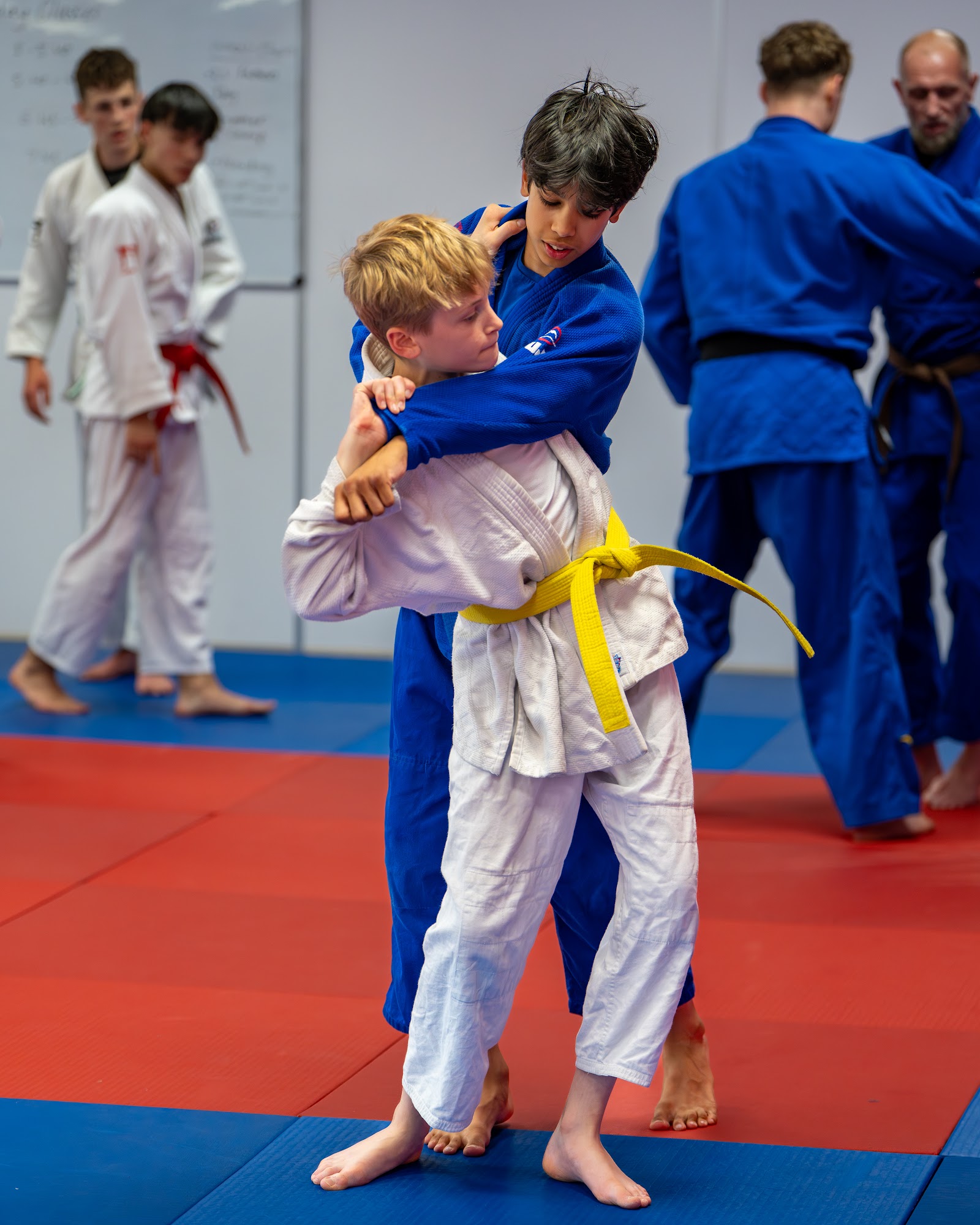
What you are watching is the trek to his first base camp. Before a child can throw another person safely, he has to control himself: balance on one leg, get up off the floor, fall without panicking and without hitting his head. Every throw he will ever learn is built on those things. It looks like play because, at five, play is how we learn. It is not a warm-up for the real thing. It is the real thing.
The same rule for adults
The same rule applies to adults.
A new adult does not walk in on Monday and do randori, the free-fighting part of judo, on Wednesday. They start on Positive Start, our programme for new starters aged eight and over and the first base camp on their route. Across their first classes they earn four stripes: the words and aim of judo; bowing, lining up and etiquette; how the dojo runs and how to fall; and movement and readiness. Only then do they take their first belt assessment.
The first technique on our Positive Start syllabus is not a throw. It is ushiro-ukemi, the backward breakfall: first lying down, then sitting, then standing. You learn to fall before you learn to throw, because sooner or later you will be thrown, and I want you to get up smiling.
Those are our fixed ropes. We put them in before you need them.
Every belt unlocks the next level
If your children play video games, you already understand the rest. Nobody starts on the final level. New levels open as you prove you can handle the ones before.
Our gradings work the same way. Each belt unlocks more: new throws, new hold-downs, the links that take you from a throw straight into a pin and, when you are ready for it, randori. The harder levels are not being kept from you. They are waiting until you can enjoy them.
The summit is not the end
Most people think black belt is the summit, and the summit is the finish line.
Ask anyone who has stood there. It isn’t.
The first black belt is called shodan. Literally translated, it means ‘beginning degree’. The people who built this system took the grade most of us think of as the top and named it with the word for beginning. They knew what they were doing.
Think about Hillary. After 1953 he kept going back to the Khumbu valley. In 1961 his Himalayan Trust opened a school in the village of Khumjung, the first of twenty-six schools it would build, along with two hospitals, for the Sherpa communities who had helped him climb. The summit did not finish his story. It gave him the view to see what to do next.
When you earn a black belt, the questions change. Can I make this throw better? Can I make it faster, with less effort? Can I do something with it that nobody has done before? And the biggest question of all: can I help someone else make the climb?
The Japanese have a word for the first habit: kaizen, small improvements made every day, with no finish line. Judo’s founder had a phrase for the second: jita kyoei, mutual welfare and benefit. You get better, you help the people around you get better, and everyone climbs. Neither stops at black belt. That is where both begin in earnest.
Everyone can. Not everyone will.
I want to be honest with you about one thing.
Everyone who walks through our door can earn a black belt. The route is mapped and the ropes are fixed. But not everyone will. Some will find the climb harder than they expected. Some will reach a base camp and decide it is high enough. That is their choice, and it is a real one.
The ones who keep going find something at the top that is hard to explain until you have seen it. They see themselves differently. They know what they will do when life gets hard, because they have already done it, one grading at a time, for years.
Base camp
So when your five-year-old slaps the mat at his first grading, or when a woman in her fifties ties a white belt for the first time and wonders whether she has left it too late, I want you to see what I see.
Not a little boy playing. Not a woman who has missed her chance. Two climbers at the start of the trail, looking up.
We know this mountain. We have members at every stage of it, from three-year-old Tigers on their first stripe to black belts who are still climbing. We know where the ice gets steep, and where people get tired and think about turning round. We built the route and fixed the ropes to see them through.
On a clear morning, from the summit of Everest, you can see six other mountains over 8,000 metres high. Nobody stands up there and thinks, well, that’s that. They look out and see how much more there is.
A black belt feels the same. It is the first time you are high enough to see the rest of the range.
Shodan. The beginning degree.
See you at base camp.
Vince Skillcorn
Head Coach, Fighting Fitness Judo
P.S. If you are standing at the bottom of the mountain, for your child or for yourself, the first step is an intro class at our Woking or Guildford dojo. Book one, and we will show you the route.