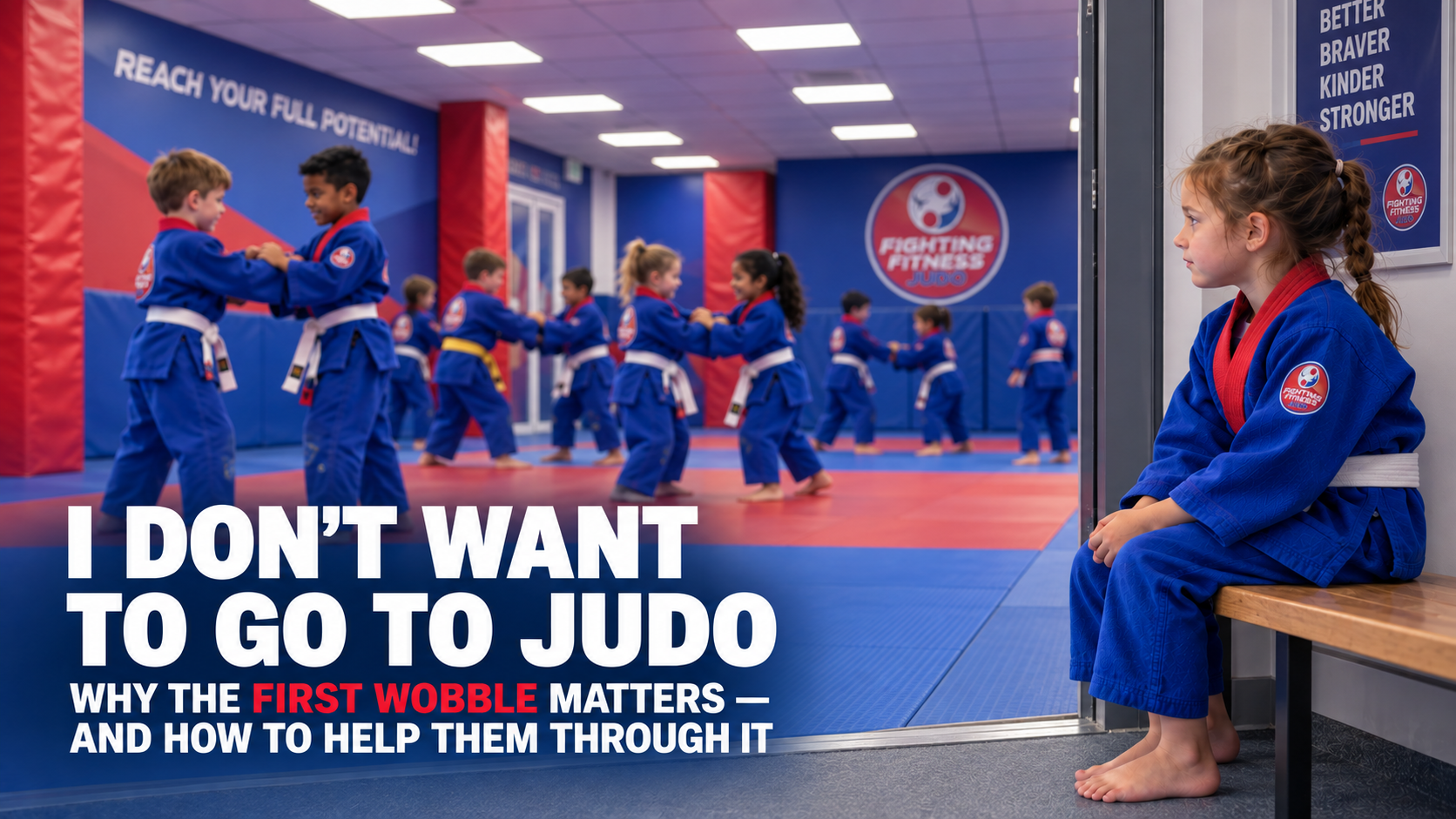
A practical guide for parents when the excitement of starting judo meets the first difficult few weeks.
The first week, many children cannot wait to get on the mat. Their new judo suit feels exciting. They learn how to fall safely, play new games, meet their coaches and come home eager to show you what they can remember.
Then, a few weeks later, something changes.
“I don’t want to go tonight.”
“It’s too hard.”
“I’m not very good at it.”
“Can I stop?”
For a parent, this can be difficult to navigate. You do not want to force a child to remain in something they genuinely dislike or that does not feel right. But you also do not want one awkward week to make a long-term decision for them.
So how do you tell the difference between the wrong activity and the first important part of learning?
The early wobble is not a deadline
At Fighting Fitness Judo, we sometimes see a child’s first wobble after the novelty of starting has worn off. It can happen after a few weeks, although every child is different and there is no universal timetable.
At first, almost everything feels new: the dojo, coaches, uniform, games and stepping onto the mat. After several sessions, a child begins to realise that learning judo also means listening when they would rather move, concentrating when their attention wanders, working with different partners, repeating skills and trying again when something does not work immediately.
That is often where the real value of judo begins.
The reason they want to stop may be the reason they started
Parents rarely bring a child to judo because they are already brilliant at concentrating, handling frustration or persevering. Usually, they hope judo will help their child become more confident, focused, physically capable and comfortable around other children.
There is a difficult truth inside that hope: a child cannot develop perseverance without occasionally having something to persevere with. They cannot become more confident without sometimes feeling uncertain. They cannot learn to manage frustration without safely experiencing it.
That does not mean every child should be made to continue indefinitely. It means a difficult evening should not automatically decide the whole journey.
What the research says about continuing in sport
There is no reliable scientific rule saying that every child will want to quit after exactly three, six or twelve weeks. Researchers define and measure sport drop-out in different ways: a child may leave one club, change activities or stop organised sport altogether.
However, a systematic review and meta-analysis of youth-sport research found that enjoyment, perceived competence, and support from parents, coaches and peers were all associated with young people’s likelihood of continuing in sport. Zhang, Wang and Shao’s review is useful here because it points away from one simple explanation: a child’s decision to continue is shaped by how capable, supported and connected they feel over time.
That is why a parent’s response, a coach’s awareness and a child’s relationship with the group can matter as much as whether they found one class difficult.
Fun does not have to mean easy
One of the biggest misunderstandings in children’s sport is the idea that an activity is only fun when it feels easy.
Research into the Fun Integration Theory found that children, parents and coaches described fun as much more than entertainment. Trying hard, positive coaching, learning and improving, friendships and being a good teammate all mattered. Visek and colleagues’ research was based on youth-sport participants, principally in football, but its practical message is highly relevant: children can be challenged, recover from a mistake and still leave feeling proud.
Good coaching does not remove effort. It makes effort feel purposeful, achievable and rewarding.
That is why our children’s classes include games, challenges, partner work and age-appropriate activities. Children may experience them as play, but they are also developing movement, balance, coordination, decision-making, cooperation and judo-specific skills. For a closer look at why this matters, read Why Great Children’s Judo Classes Look Like Play.
What might “I want to quit” really mean?
Young children do not always have the language to explain what is troubling them. “I don’t like judo” might mean:
- “I did not understand the technique.”
- “Someone else could do it and I could not.”
- “I wanted to work with my usual partner.”
- “The coach corrected me and I felt embarrassed.”
- “I was tired after school.”
- “I do not like being a beginner.”
- “I am worried I will get something wrong.”
- “I had one difficult class.”
Those experiences are real and should not be dismissed. But they do not all need the same solution, and they do not all mean leaving is the right answer. Before deciding, it helps to understand what a child is actually trying to tell you.
Eight things parents can do when a child wants to quit
1. Do not decide in an emotional moment
Immediately after a difficult class—or just before leaving the house—is rarely the best time to decide whether a child should stop. Acknowledge how they feel, let the emotion settle and return to the conversation when everyone is calm.
A useful family rule is: we do not make permanent decisions on bad days.
2. Ask better questions
“Did you enjoy it?” often produces a one-word answer. Try asking what felt difficult, who they worked with, what they learned, what the best part was, and what could make the next class feel better.
These questions can help separate a temporary frustration from a genuine, ongoing concern.
3. Agree a proper settling-in period
Rather than reconsidering before every session, agree on a calm, pre-arranged review point: perhaps a set number of classes before you discuss the decision again.
This is not about trapping a child in an activity. It gives them enough time to move beyond the awkwardness of being completely new and experience some genuine progress.
4. Speak to the coach before stopping
Please do not wait until you have decided to leave before letting us know a child is struggling. A coach may be able to pair them with a particularly supportive partner, set a small achievable goal, explain something that was misunderstood, adjust the level of challenge or help them feel more connected to the group.
Sometimes one small change can transform how a child feels about coming to class.
5. Support them without creating pressure
Support and pressure are not the same thing. A study of young footballers found that the children wanted more praise and understanding and reported less satisfaction with pressure from parents; the authors emphasised the need for a balanced, supportive involvement. Read the open-access study.
Support can sound like this:
“I understand that it felt difficult. Learning new things can feel like that. Let’s speak to your coach and work out what would help.”
It sounds less like this:
“You are going, and I do not care how you feel.”
The aim is calm encouragement: firm enough to help a child through a temporary challenge, but curious enough to recognise a genuine problem.
6. Praise what they can control
Children often judge progress by comparing themselves with somebody else. Help them focus on behaviours they can control: turning up, listening, trying again, being a good partner, staying involved after a mistake or remembering one more detail than last week.
Confidence is rarely something a child receives before taking action. It is something they build after doing difficult things and discovering that they can cope.
7. Protect the routine
If attending judo becomes a fresh negotiation every week, resistance can quickly become part of the routine. Where possible, treat class like another established family commitment: the bag is packed, the class is in the diary and turning up is the normal expectation.
Motivation naturally rises and falls. A routine can carry a child through a temporary dip in enthusiasm.
8. Notice the difference between discomfort and distress
There are occasions when pausing, changing class or stopping may be right. Persistent concerns should always be taken seriously, especially if a child feels unsafe, is being bullied or humiliated, has pain or injury, is showing worsening anxiety, or has needs the class cannot safely support.
The goal is not to teach children that they must remain in every situation regardless of how it affects them. It is to help them distinguish between:
“This is difficult because I am learning.”
and:
“This environment is genuinely wrong for me.”
That distinction is an important life skill in itself.
Where rewards and incentives fit
Small awards, certificates and progress goals can be useful in the early stages. They make effort visible and tell a child: “We noticed that you kept trying.”
But an incentive should be a bridge, not the final destination. Over time, we want children to discover the deeper rewards of judo: becoming capable, learning skills, spending time with friends, contributing to a group and feeling proud of how they responded when something was difficult.
A prize may help them reach the next session. A growing sense of identity—“I am a judoka”—is what can help them keep training.
A judoka is not someone who never struggles
Every experienced judoka has had difficult sessions. They have been thrown, forgotten techniques, lost contests, struggled with motivation and gone through periods where progress felt slow.
The difference is not that successful judoka find everything easy. It is that, with the right support, they learn how to respond.
That lesson reaches beyond the dojo. It matters when schoolwork becomes difficult, friendships become complicated or confidence is shaken.
So if your child says they want to stop after a difficult class, listen carefully. They may need a change, reassurance or the coach’s help. But they may also be standing at the beginning of the very lesson you hoped judo would teach them.
Do not dismiss their feelings. Do not pressure them into silence. But do not let one difficult week make the whole decision either.
Talk to us about your child’s first few weeks
If your child is new to judo, shy about starting or going through a difficult patch, we would rather hear about it early. Explore our children’s judo programmes, find a class in Woking or Guildford, or book a free trial class.
Our current offer is one free trial class, plus £100 off the enrolment fee when you join.
Frequently asked questions
Should I make my child continue judo if they want to quit?
There is no single answer. Start by understanding why they want to stop, speak to their coach and agree a calm review point. A one-off difficult class may need encouragement and support; persistent distress, safety concerns or bullying need prompt attention.
How long should a child try judo before deciding?
There is no universal number of sessions. A short, pre-agreed settling-in period can give a beginner time to understand the class, get to know their coaches and experience progress before making a lasting decision.
Is it normal for a child to find judo hard at first?
Yes. Judo is a new physical and social environment: children learn movement, partner work, listening, safe falling and how to respond when something does not work straight away. The challenge should be age-appropriate and supported—not overwhelming.
What should I say to my child before a difficult class?
Keep it simple and calm. Remind them that being new is allowed, the coach is there to help and the goal can be one small thing: turn up, try one activity or tell the coach what feels difficult.
Further reading
- Zhang, Wang & Shao (2022): Predictors of Persistent Participation in Youth Sport
- Bonavolontà et al. (2021): The Role of Parental Involvement in Youth Sport Experience
- Visek et al. (2014): The Fun Integration Theory
- Visek et al. (2018): Perceived importance of the fun integration theory’s factors and determinants