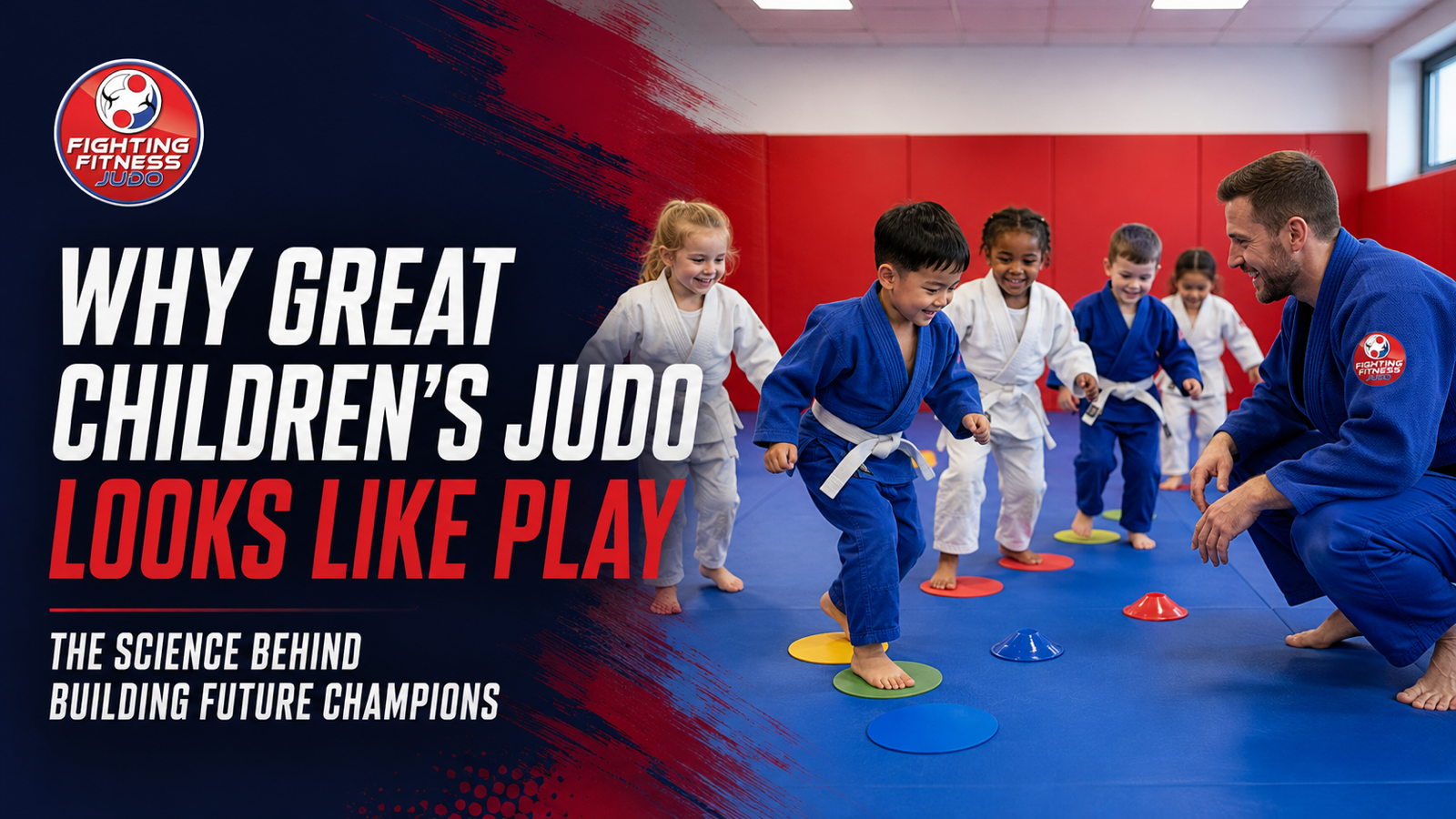
Why Great Children’s Judo Classes Look Like Play
A coach explains why the games in a well-run children’s judo class are part of the learning, not a break from it.
A dad recently decided not to enrol his child in our judo classes because, in his words, we were not a “fighting club”.
That may seem like a strange thing for me to share. After all, I am supposed to be explaining why Fighting Fitness Judo is right for your child, not giving you a reason somebody chose to walk away.
But his comment matters. And, in one sense, he was not entirely wrong.
His child had joined one of our classes for five-to-seven-year-olds. There were games. There was laughter. The children were not being marched up and down the mat, drilling throws hundreds of times or practising adult techniques.
It was not a “fight class”.
But he was wrong about what that meant.
What looked like play was carefully designed coaching. The children were developing balance, coordination, reactions, body awareness, falling skills, decision-making and confidence. They were learning to work with a partner, manage physical contact, follow instructions and solve movement problems.
They just did not realise how much work they were doing.
That is not an accident. It is what excellent coaching for young children should look like.
I know what serious judo looks like
I am not uncomfortable with competition. My wife and I both represented Great Britain internationally and travelled the world competing in judo. I have also worked with Olympic and world-level athletes.
I know how physically and mentally demanding elite sport becomes. I know what it takes to keep training when you are tired, uncomfortable, frustrated or under pressure.
One of our ambitions at Fighting Fitness Judo is to develop genuinely world-class judoka. But world-class athletes are not created by treating six-year-olds like miniature adults.
They are created by understanding what a six-year-old needs today, so they still love learning, training and improving years from now.
If we want children to become exceptional, we cannot begin by making them endure the version of training designed for the finished athlete. We have to build the foundations first.
Viral fighting clips are not a coaching curriculum
Social media is full of impressive-looking clips. You may see a very young child performing a sophisticated submission, jumping into an armlock or applying a strangle. The technique looks advanced, the clip attracts attention and people understandably think: “That child can really fight.”
A child may be physically capable of copying a movement. That does not mean they fully understand the possible consequences of applying it to another person, or have the judgement and emotional maturity to use it responsibly.
That distinction matters.
Good children’s martial-arts coaching is not about teaching the most dramatic technique at the youngest possible age. It is about introducing the right skills, in the right way, at the right stage of development.
That is why our SuperKids judo classes for ages 5–7 focus on fundamental movement, balance, coordination, breakfalls, judo-specific skills and learning to work safely with other children. We want children developing physically, technically, socially and emotionally.
We do not need to rush them into adult techniques to prove that the class is serious. That does not make children’s judo soft. It makes it responsible.
“But there was too much playing…”
I suspect the dad’s real concern was not that we failed to teach his child how to fight. I think he saw children playing and assumed they were not learning enough.
That is understandable. If you do not know what the coach is looking for, a good game can appear to be nothing more than entertainment. But an experienced coach sees something completely different.
We see whether a child can change direction without losing balance; react to another person’s movement; protect their head when they fall; control their own strength; recognise space, timing and opportunity; and adapt when a problem changes.
The game is not a break from the learning. The learning is inside the game.
For parents of a shy or nervous child, our guide to building confidence in quiet children explains why a clear, supportive activity can make the first step feel more manageable.
How children acquire judo skills
There are two broad coaching approaches worth understanding. Both are valuable. Both belong in a good judo programme. The skill is knowing when and how to use each one.
1. Traditional or linear instruction
This is the approach most parents immediately recognise as coaching. The coach demonstrates a movement, the children copy it, the coach corrects them, and they repeat it.
We use this kind of teaching. It is valuable when children are learning the basic shape of a movement, developing safe falling habits or need clear guidance on an important technical detail. Repetition matters.
But judo never happens against a partner who stands perfectly still and responds in exactly the same way every time. A technically beautiful throw is of little use if a judoka cannot recognise when, where or why to use it.
That is where the second approach becomes important.
2. The constraints-led approach
A constraints-led approach changes elements of a task so that children have to discover effective solutions. The coach may adjust the available space, starting grip, direction of movement, scoring method, target or options available to each partner.
Instead of telling a child every movement to make, we create a carefully controlled problem that encourages the right movement to emerge. For example, a game might ask a child to move their partner towards a particular area without using force. To succeed, they begin experimenting with balance, direction, timing and reaction.
To the child, it feels like a challenge. To the coach, it is a lesson in kuzushi — the disruption of balance that sits at the heart of effective throwing.
Research on constraints-led learning describes how task, performer and environmental constraints can be used to support adaptable movement and decision-making. Renshaw and colleagues’ peer-reviewed overview explains the approach in physical education, while Warner and Kanamaru’s judo-specific chapter considers its relevance to developing judoka.
This is not unstructured free play. The coach must understand the skill well enough to design a game that draws it out. That requires more coaching knowledge, not less.
We do not choose between technique and play
This is not an argument that repetition is bad and games are good. Children need both.
We might isolate a movement so they can understand its basic shape. Then we place that movement inside a game where they have to recognise an opportunity, adjust to a partner and make a decision.
One approach helps to build the movement. The other helps a child learn to use it.
The balance changes with a child’s age, experience and stage of development. That is coaching: not following the same lesson plan for every age, not rushing children into advanced techniques because they look impressive online, and not mistaking seriousness for quality.
Before children will work like champions, they need to love the sport
There is another reason play matters: motivation.
Elite sport is hard work. The best athletes train through difficult days because, underneath all the sacrifice, they have a powerful internal reason to continue. They love their sport, they love improving, they love the challenge, the people and the feeling of getting better.
That internal drive is known as intrinsic motivation. Self-Determination Theory highlights the roles of autonomy, competence and relatedness. In straightforward terms, young athletes are more likely to develop strong internal motivation when they experience appropriate ownership, progress and connection with the people around them. Research by Amorose and Anderson-Butcher links athletes’ perceptions of autonomy-supportive coaching with these needs and with more self-determined motivation.
That is why a great children’s class should help a child feel:
“I can do this. I’m getting better. I belong here. I want to come back.”
If we destroy that feeling at six by making every session repetitive, intimidating or relentlessly results-driven, it does not matter how serious the training looked. We may have lost the athlete before their journey truly began.
What “fighting spirit” should look like at six
We absolutely want to develop strong competitors. But at five, six or seven years old, fighting spirit does not mean applying adult submissions or being pushed through a miniature fight camp.
It looks like getting back up after a fall, trying again when a movement feels difficult, staying calm when a game does not go their way, listening when they would rather rush ahead, learning to lose without making excuses, and learning to win without making somebody else feel small.
It looks like controlling their body so their partner feels safe, and finding the courage to join in when they initially felt nervous.
Those qualities are not alternatives to becoming competitive. They are the beginnings of it.
Before a child can become a world-class competitor, they need to become a capable mover, an enthusiastic learner, a safe training partner and a young person who wants to return to the mat. That is what we are building.
What parents should look for in a children’s judo class
Do not judge a class only by how serious it appears. Look more closely.
A parent’s checklist
Six signs of a class that is building the right foundations
Engaged children
Enjoyment helps a child stay open to learning and come back willingly.
Safe falling instruction
Breakfalls are a core judo skill and should be taught progressively.
Age-appropriate challenge
The difficulty should meet the child where they are, rather than copy adult training.
Clear purpose behind activities
A coach should be able to explain what an exercise or game is developing.
Respectful partner work
Children should learn to control themselves so that training remains safe for everyone.
A willingness to try again
Confidence grows when children can try, fail safely and keep learning.
A room full of silent six-year-olds repeating a movement on command may look disciplined. A room full of smiling children solving carefully designed judo problems may look like play.
The better question is not, “Which class looks more serious?” It is: “Which class is developing the skills and motivation my child will need for the long term?”
So, are we a fighting club?
If by “fighting club” you mean a room where six-year-olds are expected to train like adults, drill dangerous techniques and prove how tough they are, then no. We are not that club.
We are a judo club with serious ambitions and age-appropriate methods. We want children to become skilful, confident, disciplined, resilient and respectful. We want those who choose a competitive pathway to receive the foundations they need to go as far as their ability and ambition can take them — perhaps even to the world stage.
But first, we want them to fall in love with judo.
Because the child who loves coming to class becomes the child who keeps learning. The child who keeps learning becomes the athlete who can handle hard work.
That is how champions are built: not by rushing the beginning, but by getting the beginning right.
Try children’s judo in Woking or Guildford
If you are looking for children’s judo classes that combine expert coaching, genuine skill development and an environment your child will look forward to attending, we would love to welcome you.
You can explore our judo classes in Woking or judo classes in Guildford, and see the age groups we teach on our programmes page.
Our current Back to School offer is one free trial class, plus £100 off the enrolment fee when you join. Claim your free trial class and see what is really happening inside the games.
You may be surprised by just how much your child is learning.
Frequently asked questions
Are judo classes safe for five-to-seven-year-olds?
A well-run class should use age-appropriate techniques, controlled activities, safe falling instruction and suitably qualified coaches. At Fighting Fitness Judo, our youngest members build fundamental movement and judo skills progressively rather than being rushed into techniques designed for older athletes.
Do young children fight in judo classes?
Children may take part in carefully controlled partner activities and age-appropriate forms of randori. These should develop movement, balance, reactions and decision-making while protecting both participants. This is very different from expecting a young child to take part in an adult-style fight session.
Why do children play games during judo?
Well-designed games allow coaches to develop balance, coordination, timing, spatial awareness, problem-solving and social skills. The activity feels enjoyable to the child, but the coach has deliberately built a learning objective into it.
Will playful classes prepare my child for competition?
Yes. Enjoyment and serious development are not opposites. Young children first need strong movement foundations, safe habits, adaptable skills and the motivation to keep training. Technical instruction, repetition and more demanding competitive practice can then be introduced progressively.
Can my child eventually become an elite judoka?
No coach can promise an elite outcome. However, the long-term pathway begins with excellent fundamentals, skilled coaching, consistent attendance and a lasting love of the sport. Our role is to give every child the strongest possible foundation and help ambitious judoka progress appropriately.
About the author
Vince Skillcorn is an international former Great Britain judo competitor and an experienced coach who has worked with Olympic and world-level athletes. Alongside his wife, also a former international Great Britain competitor, he leads Fighting Fitness Judo with the aim of helping children build confidence, character and exceptional judo skills, while creating a genuine pathway for those with the ambition to compete at the highest level.
Further reading
- Renshaw et al. (2010): A constraints-led perspective to understanding skill acquisition and game play
- Warner and Kanamaru (2018): The skill acquisition process for judo – building to a constraints-led approach
- Amorose and Anderson-Butcher (2007): Autonomy-supportive coaching and self-determined motivation in high school and college athletes